
Sarah Kenderdine, Visiting Professor of the Graduate Arts Program – PSL
Professor Sarah Kenderdine is a researcher at the forefront of interactive and immersive experiences for galleries, libraries, archives and museums. She is professor at the École Polytechnique fédérale de Lausanne (EPFL), Switzerland, leading the Laboratory for Experimental Museology (eM+) and was the director EPFL Pavilion form 2017-2024 where she is now curator-at-large. She has created over 110 exhibitions and major installations worldwide along with several permanent museums.

Portrait de Sarah Kenderdine
Computational Museology in the Age of Experience
Monday, September 29, 2025, from 6 p.m. to 8 p.m.
Place: École nationale des chartes - PSL, 65 rue de Richelieu, 75002 Paris (salle Delisle)
Computational museology is a scaffold that unites machine intelligence with data curation, ontology with visualization, and communities of publics with that world of knowledge through embodied participation. This lecture focuses on a series of works from Laboratory for Experimental Museology (eM+) which move beyond digital objects to create new kinds of experiences that combine curatorship and emerging technologies. Sharing highlights from a series of international exhibitions and ground-breaking installations, the lecture explores themes such as digital twins, deep maps, performative systems, and the role of generative AI. At its heart, computational museology seeks to connect all forms of culture and materiality: objects, knowledge systems, representation and participation. The lecture is designed for anyone interested in how museums are evolving today, from students and artists to curators and the wider public.
-

Public Portal to Anticipation, World Expo Osaka 2025. Image © EPFL Laboratory for Experimental Museology
-

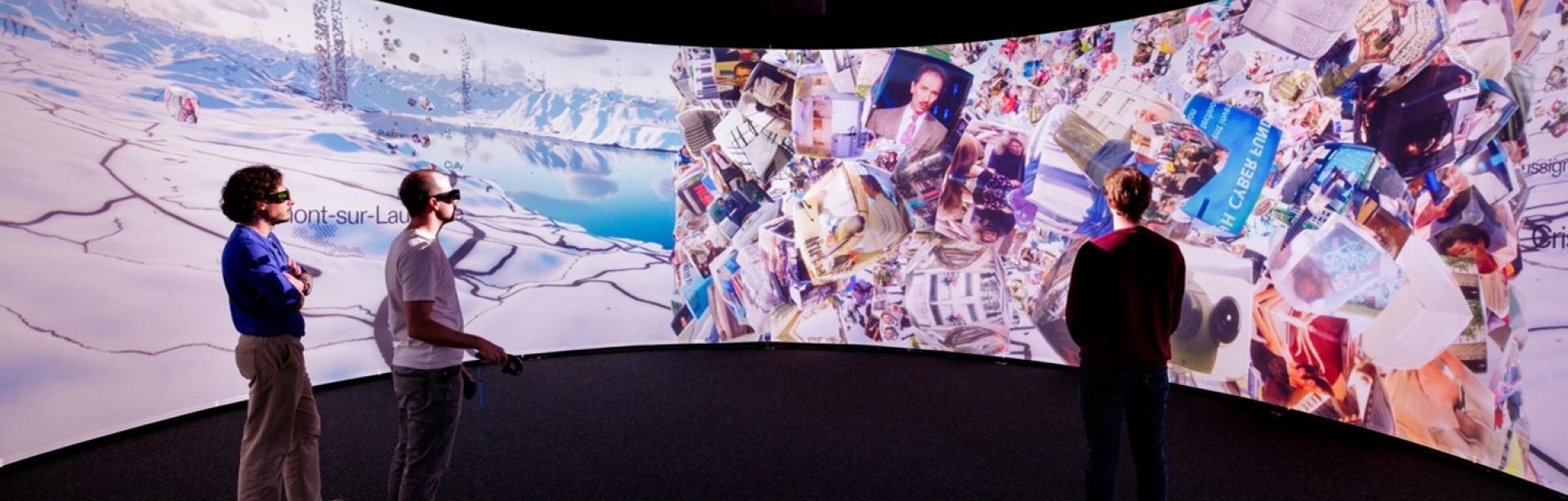
The Terapixel Panorama. Image © EPFL Laboratory for Experimental Museology.
Deep Mapping
Wednesday, October 8, 2025, from 5 p.m. to 7 p.m.
Place: ENS, 45 rue d’Ulm (salle Histoire, escalier D)
Deep mapping is an expanded cartographic practice that reimagines maps for immersive and interactive systems. It fuses critical reflection on the politics and poetics of mapping (carto-criticism) with the analytic and expressive capacities of large-scale data visualization. Within such environments, maps are not neutral containers of information, but cultural artefacts shaped by power, perspective, and narrative. Immersive interfaces amplify this by enabling users to navigate, manipulate, and reconfigure vast archival and spatial datasets. Through computational visualization, deep mapping reveals layered spatial, temporal, and social relationships that exceed conventional cartography. It is simultaneously a critique of mapping as a representational system and a generative mode of exploration: making visible hidden infrastructures, suppressed histories, and emergent patterns, while fostering interpretive, affective, and participatory engagements within interactive, multisensory domains. The exhibition series Atlas of Maritime Buddhism will focus this framework into a tangle demonstration. The Atlas has profound contemporary relevance to the socio-economic and political transformation of the world. While far reaching enterprise such as Belt and Road reactivates ancient over land and maritime trading routes, the Atlas counterbalances prevailing narratives which neglect the importance of pan-Asian maritime countries and Buddhism entrepreneurship in the expansion of trade from 2nd century BCE-15th century CE.
Deep mapping in the context of data visualization is also a technique for rendering massive archival corpora as layered, spatial narratives within immersive interfaces. Unlike conventional maps that flatten space into singular views, deep mapping integrates heterogeneous data—textual, visual, sonic, and material—into multidimensional cartographies that can be navigated, queried, and experienced sensorially. It is both carto-critical—exposing the epistemic assumptions, omissions, and power relations embedded in archives—and computationally generative, using large-scale visualization to reveal latent patterns, correlations, and absences otherwise inaccessible to human perception. In immersive environments, deep mapping transforms archival data into navigable terrains where users can move between scales, trace polytemporal connections, and engage affectively with cultural memory. An example of deep mapping can be seen in the Narratives from the Long Tail project, where we are developing interactive visualization frameworks for more than 200,000 hours of archival video drawn from four major European collections, including the International Olympic Committee archives, RTS (Swiss Radio and Television), the Eye Filmmuseum in the Netherlands and the Montreux Jazz Archive. Using machine learning and computer vision we generate “narrative coherence” across spatio-temporal, social, affective, and aesthetic dimensions of these massive datasets. At the core is a 360-degree, 3D Narrative Visualization Engine: a scalable and participatory system that situates audiences at the center of knowledge production, transforming archival exploration into an immersive, interactive, and innovative practice of cultural memory.
-
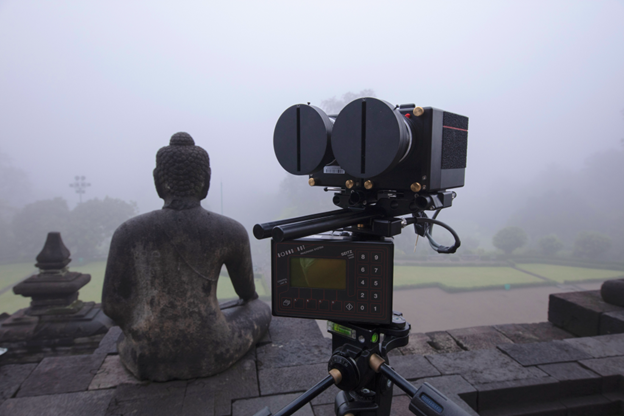
Fieldwork images for the Atlas of Maritime Buddhism, Borobudur Temple, Indonesia and Shweyattaw Buddha, Mandalay, Myanmar. Image © EPFL Laboratory for Experimental Museology
-

Fieldwork images for the Atlas of Maritime Buddhism, Borobudur Temple, Indonesia and Shweyattaw Buddha, Mandalay, Myanmar. Image © EPFL Laboratory for Experimental Museology
-

Swiss Echoes. Image © EPFL Laboratory for Experimental Museology
Future Proof
Thursday, October 9, 2025, from 6 p.m. to 8 p.m.
Place: École des Arts décoratifs, 31, rue d’Ulm (amphi Bachelier)
Generative artificial intelligence (AI) is rapidly emerging as a powerful engine for cultural imagination, capable of transforming how societies envision futures and how museums mediate knowledge. In the domain of speculative futures, generative AI extends anticipatory practices by synthesizing scientific data, social scenarios, and aesthetic forms into tangible narratives that invite collective reflection on what might lie ahead. Within museums, these capabilities offer unprecedented tools for curatorial experimentation, producing immersive simulations, narrative prototypes, and interactive environments that challenge conventional notions of authenticity, authorship, and temporality. By situating visitors as co-creators in algorithmically mediated worlds, generative AI reframes the museum as a site of foresight and debate, where cultural heritage and emergent science converge. This presentation explores the dual role of generative AI as both a speculative instrument—projecting possible, probable, and desirable futures—and as a museological catalyst that redefines exhibition-making, audience engagement, and institutional responsibilities in an age of accelerated technological change.
One example to tangibly focus the discussion is the Geneva Public Portal to Anticipation, an initiative to engage global publics with emerging science, based on the Geneva Science and Diplomacy Anticipator, Science Breakthrough Radar® compiled by 2100 leading scientists globally. The Portal is an evolving dialogue that reframes speculative futures through cutting-edge science. Uniquely, it invites citizens to actively explore these complex scientific ideas—by imagining and shaping alternative social, cultural, or technological scenarios. This science diplomacy project is currently a major installation currently running at the World Expo 2025, Osaka.
Other examples include a series of demonstrators for multiuser collaboration using generative tools such as the Collaborative Canvas and ENGINE: Embodied Generative Interaction Environment, both drawing on the largest digital image in the world, The Texapixel Panorama, a 19th century painted panorama “Panorama of the Battle of Murten” (1893/4).
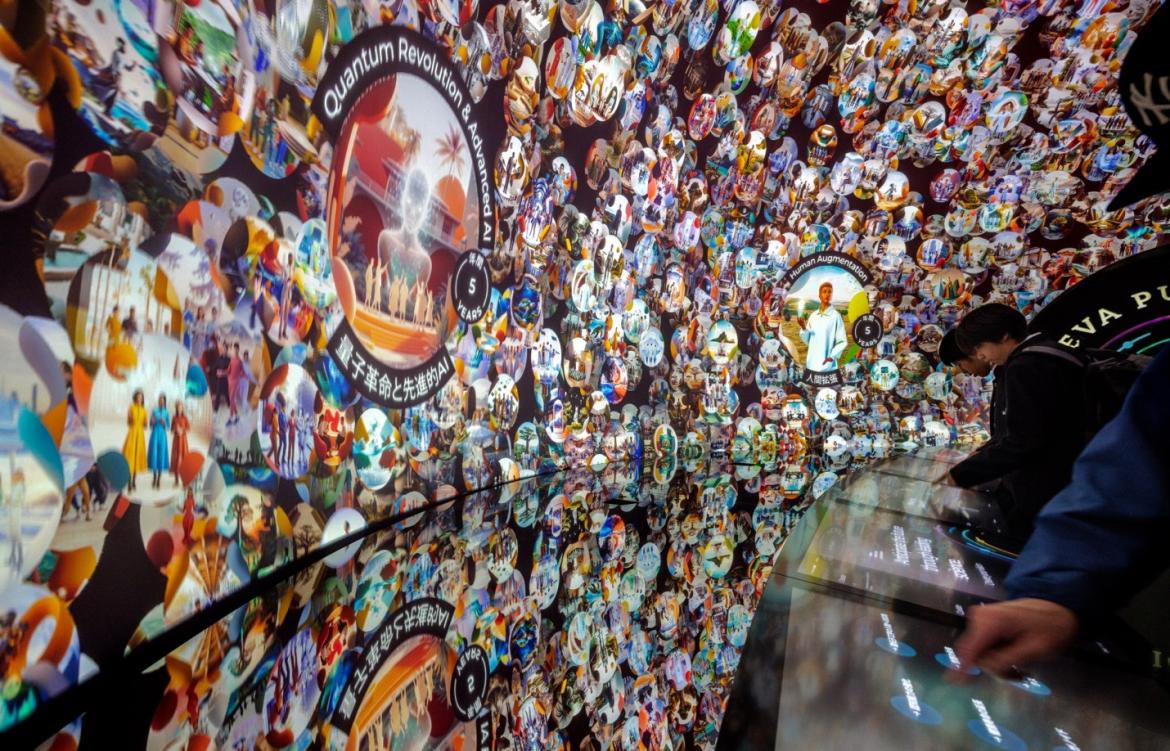
Geneva Public Portal to Anticipation, World Expo Osaka 2025. Image © EPFL Laboratory for Experimental Museology.
Deep fakes: a critical lexicon of digital museology
Friday, October 10, 2025, from 5 p.m. to 7 p.m.
Place: École nationale des chartes - PSL, 65 rue de Richelieu, 75002 Paris (salle Delisle)
This talk explores how today’s technologies such as artificial intelligence, computer vision, and immersive media, are radically transforming the way we see, understand, and preserve cultural artefacts. Replicas here are not just copies; they are provocations that compel us to rethink notions of reality, authenticity, and originality.
Through examples ranging from sacred objects and ancient sculptures to digital surrogates of cultural icons, I examine how computational processes reveal what might be called the “optical unconscious” of art—patterns and details invisible to the human eye but made legible through algorithms and interaction. These technologies invite us into new forms of sensory and performative engagement, challenging traditional boundaries between object and observer.
I call these emergent forms Cultural Deep Fakes—not to cast doubt on their legitimacy, but to foreground their complexity. They are not forgeries but technologically empowered artefacts that disclose hidden layers, propose new narratives, and stir unforeseen emotional responses. At stake are not only questions of mimesis and memory, but also the politics of replication: in contexts where heritage is threatened by war, climate disaster, or cultural erasure, digital copies can act as resilient reservoirs of memory and as instruments for reclaiming identity.
Yet these same technologies also inhabit a volatile digital economy where preservation, profit, and control blur. Cryptographic systems and speculative ownership models introduce new tensions around value, access, and the commons. At this threshold, the deep fake becomes more than deception—it emerges as a conceptual lens to rethink truth, cultural authority, and the futures of heritage.
This lecture draws on the new book: Deep Fakes: A Critical Lexicon for Digital Museology, co-authored with Lily Hibberd and published by Routledge in 2025 and two exhibitions: Deep Fakes: Art and Its Double at EPFL Pavilions, Lausanne, Switzerland (16 September 2021 – 06 February 2022) and Museum of the Future: 17 Digital Experiments at Museum for Gestaltung, Zurich, Switzerland (29 August 2025 – 1 February 2026).

Couverture du livre Deep Fakes: A Critical Lexicon for Digital Museology, from the poster for the exhibition Deep Fakes: Art and Its Double (2021) à paraître en décembre 2025